Arabic certificates done right: right-to-left design tips
Mirroring an English layout isn’t enough. Type, numerals, dates and seals all need a native touch, and the people reading your certificate will notice whether they got one.

The quickest way to make an Arabic certificate is to take the English one, translate the words and flip the layout. The result is usually readable, and it usually looks translated. Arabic readers spot it straight away: a Latin-style typeface pressed into service, letters spaced apart, the seal on the wrong side, a date written the English way.
A certificate that feels native gets six things right.
1. Mirror the reading order, not everything
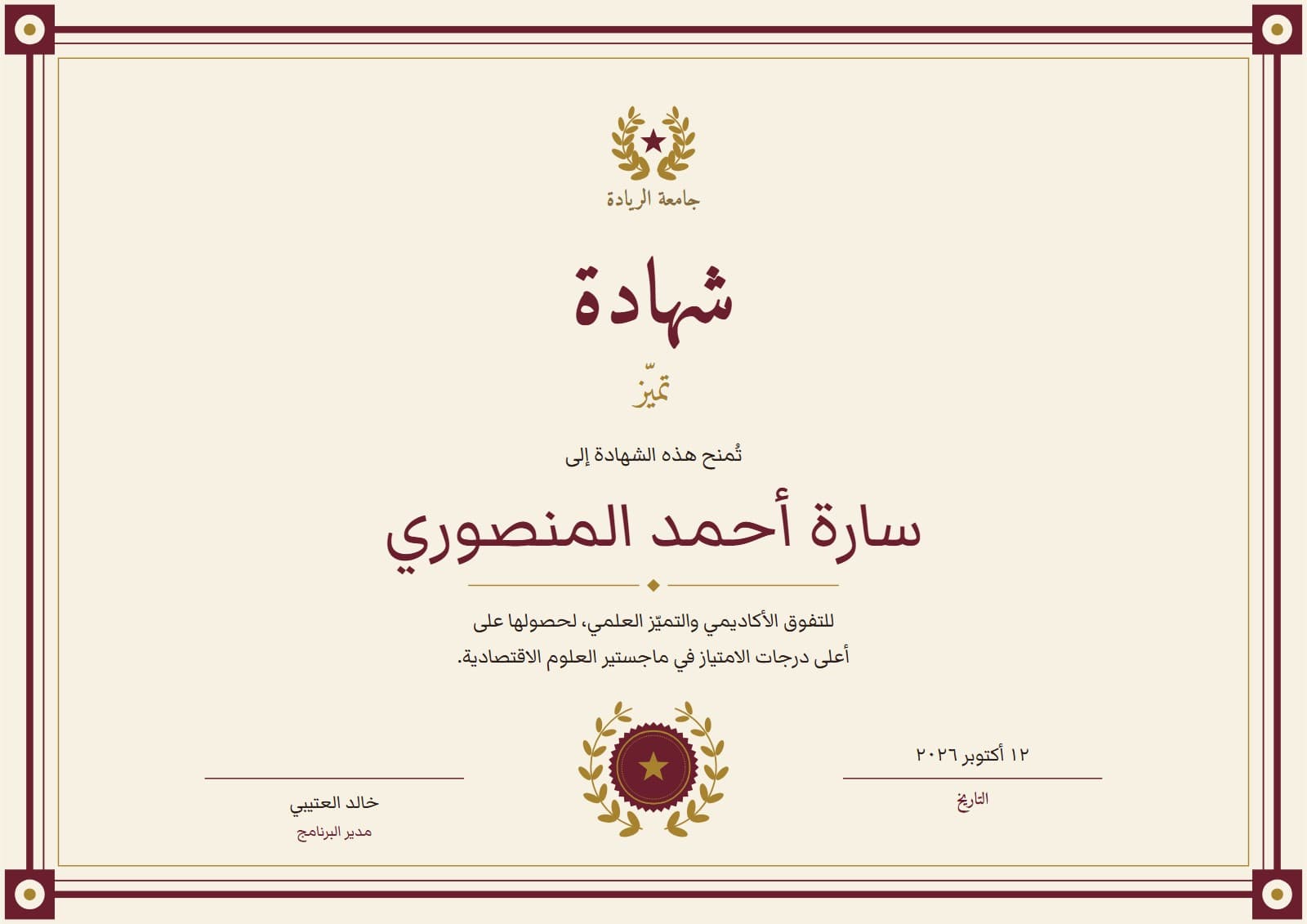
Arabic reads from right to left, so the reading path flips: the issuer and logo usually sit at the top right, text aligns to the right, and the first signature sits on the right. But not every element should flip. Logos stay exactly as their owners drew them, Latin text and URLs still read left to right, and an illustration with an obvious direction may look odd reversed. Mirror the layout, then look at each element and ask whether it should really turn around.
2. Choose a typeface made for Arabic
Arabic letters change shape depending on where they sit in a word and join to their neighbours, so a typeface needs to be designed for the script, not just to contain the characters. For a formal certificate, a Naskh-style face such as Amiri gives a classical, bookish feel; a clean sans such as IBM Plex Sans Arabic suits modern training and corporate awards. Use one for the title and name and the other for the body, the same way you would pair fonts in English.
3. Decide on numerals and stick to them
Arabic is written with two sets of digits: the Western digits 0 to 9, used across North Africa and widely online, and the Eastern Arabic digits ٠ to ٩, common in much of the Gulf and the Levant. Both are correct. What looks careless is mixing them, with Eastern digits in the date and Western digits in the certificate number. Choose what your readers expect and use it everywhere on the page.
4. Write dates the way your readers do
Write the month as a word, so nobody has to guess between day-month and month-day. Month names themselves vary: “أكتوبر” is common in Egypt and the Gulf, while “تشرين الأول” is used in the Levant and Iraq. Where the Hijri calendar is expected, for example in Saudi Arabia, many institutions show the Hijri date alongside the Gregorian one. Check which your audience uses before you print a whole cohort.
5. Treat names with care
Arabic names are often written with three or four parts, the given name followed by the father’s and grandfather’s names and the family name, and many institutions print the full form on formal certificates. Ask for names exactly as they should appear, including any “bin” or “bint”, and don’t shorten them to fit a layout designed for “first name, last name”. A good Arabic design gives the name line room for a long one.
If your list comes from a spreadsheet, Arabic headings such as “الاسم الكامل” or “البريد الإلكتروني” are matched automatically when you issue in bulk with Certale. Our guide to bulk certificates from Excel covers saving the file so the Arabic text survives.
6. Handle the Latin bits gracefully
Most Arabic certificates still carry some Latin text: a brand name, a web address, a certificate code, an email. Inside a right-to-left line, these can jump to the wrong place or drag punctuation with them. Keep them on their own line where you can, or make sure your design tool isolates them so they keep their left-to-right order. Then read the printed proof, not just the screen.
Bilingual, or two editions?
A single certificate with both languages side by side is common for official documents, but it halves the space for each language and makes the design busier. For most awards, two separate editions, one designed for Arabic and one for English, look better and let each language breathe. Certale’s library includes a native Arabic edition of its designs for exactly this reason, and every story page and verification check works the same way in both languages.
The Certale team
Certale, by PPT-Design LtdWe design Certale’s 1,000+ certificate templates and build the app that issues and verifies them. In the Journal we share what we have learned about recognising people well: the wording, the design and the practical side of getting certificates into the right hands.