
Employee of the month certificates that people actually keep
Most recognition certificates are read once and forgotten. A few end up pinned above a desk for years. Here is what the second kind do differently, and how to make yours one of them.

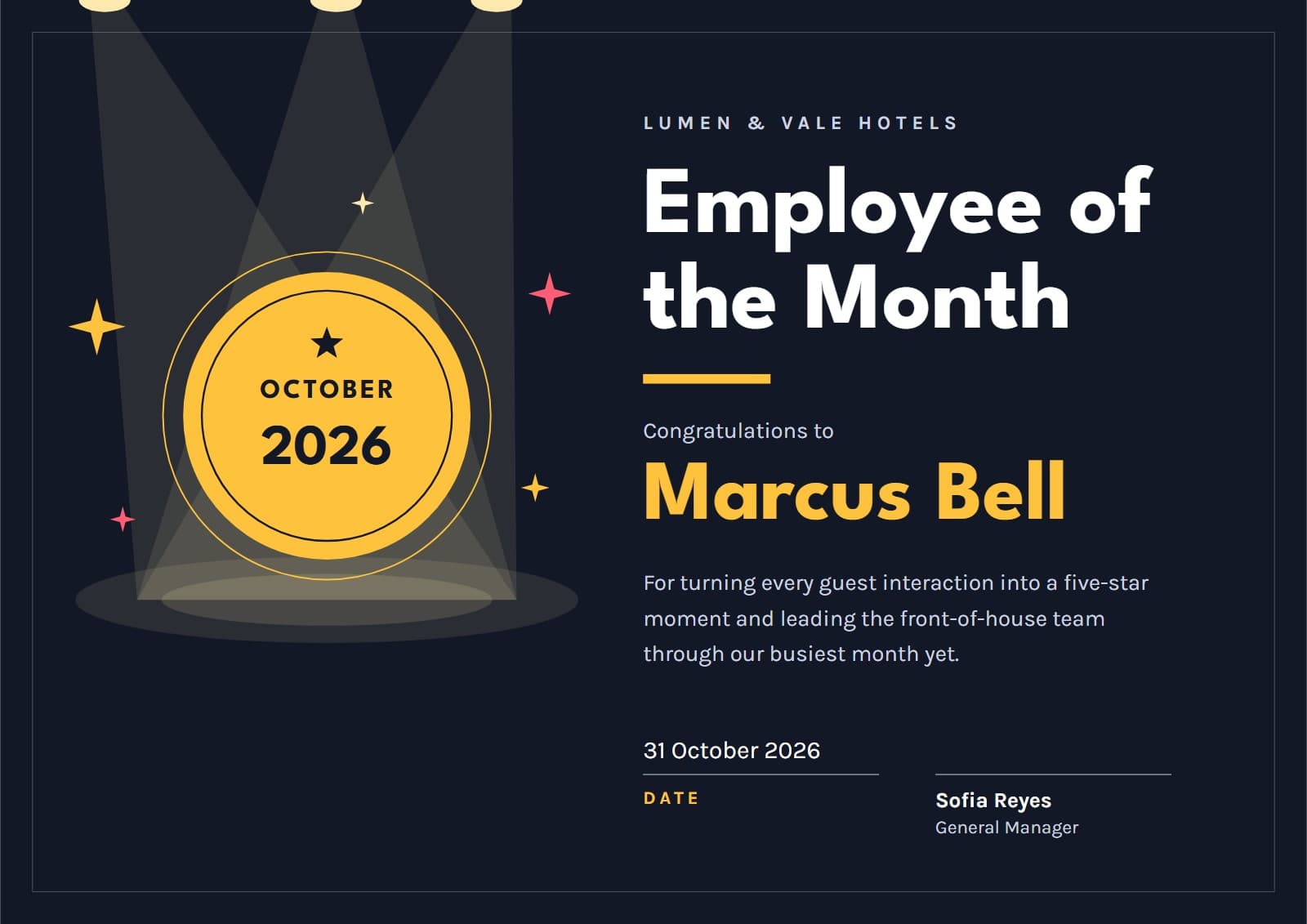
Why some certificates get kept
Walk past enough desks and you start to see a pattern. The certificates still pinned up years later are rarely the most expensive-looking ones. They are the ones that said something true about the person who earned them, handed over at a moment that felt like an occasion.
A certificate is a small, physical promise that someone noticed. When the wording is generic, the promise is empty: “for outstanding contribution” could be about anyone. When it is specific, it becomes evidence. People keep evidence. They show it to their family, photograph it, and bring it up in their next review.
Employee of the month awards are especially easy to get wrong because they repeat. By the sixth month it is tempting to reuse last month’s wording and change the name. Recipients notice. The fix is to treat every certificate as a one-off, even when the format stays the same.
None of this needs a bigger budget. It needs a little more care in six places.
1. Name the one thing they did
Replace “for hard work and dedication” with the moment that earned the award. One sentence is enough: what they did, and what changed because of it. “For calmly rehousing forty guests when the boiler failed on New Year’s Eve” tells everyone in the room, and everyone who sees it later, exactly why this person was chosen.
Ask the nominating manager for one concrete example before you design anything. If they can’t give one, that is worth knowing too.
2. Present it, don’t just send it
An award that arrives as an attachment between two meeting invites feels like admin. Take two minutes at a team meeting, a shift briefing or the start of a video call. Read the reason out loud and let people clap. The certificate becomes a souvenir of that moment, which is a big part of why people hold on to it.
Who presents it matters as well. A few words from the winner’s own manager mean more than a message from a distant inbox, and a senior leader who has clearly read the reason is better still.
For remote and shift-based teams, email the certificate afterwards so nobody misses out, but let the moment come first.
3. Make it look worth keeping
Design signals value. A clear order (award, name, reason, date, signatures), generous white space and your own colours tell the recipient this isn’t a template someone forgot to finish. Use one or two typefaces, not five. Give the name room to breathe: it is the first thing everyone looks at.
If you print, paper matters. A heavier, matte stock feels more permanent than everyday office paper, and it looks better in a frame. A real signature in ink, even on a printed certificate, still beats a scanned one. If the certificate carries a QR code, tuck it into a corner where it won’t compete with the name, and keep it large enough to scan from a phone held at arm’s length.
4. Get the wording right
Good recognition wording has three parts: the award, the specific action, and its effect on colleagues or customers. Keep the reason under thirty words, so it fits comfortably on the certificate and can be read aloud in one breath.
Avoid in-jokes that new starters won’t understand. And check the spelling of the recipient’s name with them directly, not with the HR system, which may have it wrong. For more lines to adapt, see our 50 wording ideas for certificates of appreciation.
“People don’t keep certificates. They keep proof that someone noticed.”
5. Let them share it, if they want to
A printed certificate lives on one desk. A shareable one can reach the recipient’s family, friends and professional network. Every Certale certificate carries a QR code that opens its own verified story page, where the recipient can add a line about what the award means to them and share it to LinkedIn or WhatsApp in a tap.
Recipients choose who sees it: private, link-only, or public on the Wall of Tales. Make sharing an invitation, never an expectation. Some people would rather keep it to themselves, and that is fine. For hotels, shops and other customer-facing teams, a public story page can also quietly show customers the kind of service your people are proud of.
6. Make it a rhythm, not a lottery
Monthly awards lose their meaning if winners seem random, or if the same three people keep winning. Publish simple criteria, rotate who nominates, and keep the design and timing consistent, so the award builds a reputation of its own. Twelve well-chosen winners a year will do more for morale than fifty rushed ones.
Ask for nominations from peers as well as managers. Colleagues often see the quiet, behind-the-scenes work that managers miss, and being nominated by the people you work beside is a reward in itself.
Keep a short record of past winners and their reasons. It makes the annual awards easier to judge, and gives you a year of stories to celebrate in December. If you run several programmes at once, our guide to employee recognition certificates shows how to issue them all from one HR export.
Before you press issue: a checklist
Tick these off for each month’s winner.
None of this takes long. Ten extra minutes on the reason, two minutes of ceremony and a design you are proud of are usually the difference between a certificate that gets binned and one that is still on the wall when the next one arrives.
The Certale team
Certale, by PPT-Design LtdWe design Certale’s 1,000+ certificate templates and build the app that issues and verifies them. In the Journal we share what we have learned about recognising people well: the wording, the design and the practical side of getting certificates into the right hands.